
Aluminum alloy products
AoTingBao interior door, produced by the original factory, combines design aesthetics and durability performance
Main product series
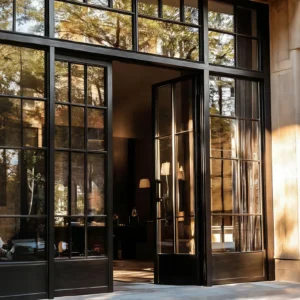
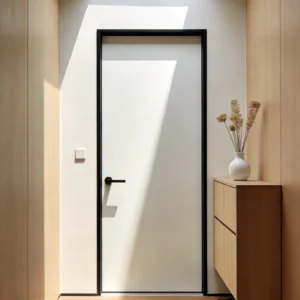
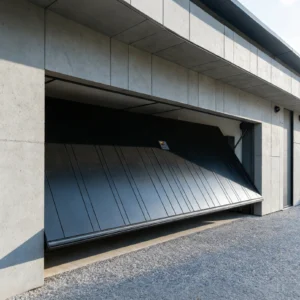


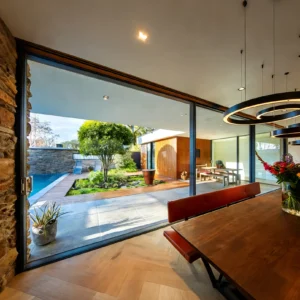
Suitable for any scenario
Residential+Villa
Commercial+office building
Office+School
Apartment+Hotel
Product Process and Environment
Production environment
Core equipment:
Equipped with an automated precision sawing system and welding workstation, ensuring that the machining accuracy of core structural components reaches ± 0.1mm
Production line layout:
Adopting a “U-shaped modular” production line instead of traditional long assembly lines. This layout can flexibly respond to customized orders from multiple batches or small batches, reduce the accumulation of work in progress, and achieve efficient one-way flow from materials to finished products. It is particularly suitable for the production organization of complex customized parts
Production process
Material selection:
Mainly using 6063-T5 national standard aluminum profiles, which have balanced strength, corrosion resistance, and extrusion formability. Each batch of materials comes with a material report and is sampled for spectral analysis to verify its composition
Cutting and processing:
The profile is cut to a fixed length using a double headed precision saw, and the cut is free of burrs. All lock holes and handle holes are completed in one go on the CNC machining center, eliminating accumulated positional errors and ensuring precise fitting of hardware installation
Surface treatment
We provide various mainstream processes such as spray coating (powder/fluorocarbon), wood grain transfer printing, anodizing coating, etc. Spraying is carried out in a dust-free workshop, which undergoes pre-treatment (degreasing, chroming), electrostatic spraying, and high-temperature curing at 230 ℃ to ensure strong adhesion, uniform color, and weather resistance of the coating
Assembly and polishing:
The corner assembly adopts the injection of adhesive corner code technology, and specialized corner assembly adhesive is injected after mechanical collision to achieve dual protection of mechanical strength and sealing. All welds and seams have undergone three sanding treatments to achieve a smooth “zero level” standard for tactile sensation
Quality inspection
Raw Material Inspection (IQC):
Conduct random inspections on all incoming aluminum materials, glass, coatings, and hardware, verify the model, specifications, quantity, and supplier factory reports, isolate and return non-conforming products
Production Process Inspection (IPQC):
Multiple quality control points are set up on the production line, with operators conducting first piece inspections and dedicated quality inspectors conducting regular inspections, with a focus on monitoring dimensional tolerances, assembly clearances, and surface defects
Finished product performance inspection (FQC):
This is the core inspection process. Each door must pass through:
- Functional testing: Simulate use and conduct tens of thousands of opening and closing fatigue tests.
- Performance testing: Use professional equipment to test air tightness, water tightness, and wind resistance (if applicable).
- Appearance inspection: In the dedicated lighting inspection section, conduct a 360 degree inspection of the surface for scratches, color differences, particles, and other defects.
Packaging Protection Inspection (OQC):
Check whether the packaging materials (corner protectors, pearl cotton, cardboard boxes) are qualified, whether the product information labels are accurate, and ensure that the transportation protection meets the established standards
Final Audit:
Before the finished products are put into storage, a batch sampling audit is conducted to verify the consistency between the documents and the physical objects. Only products that have passed all tests can obtain the “allowed to leave the factory” status and enter the logistics system